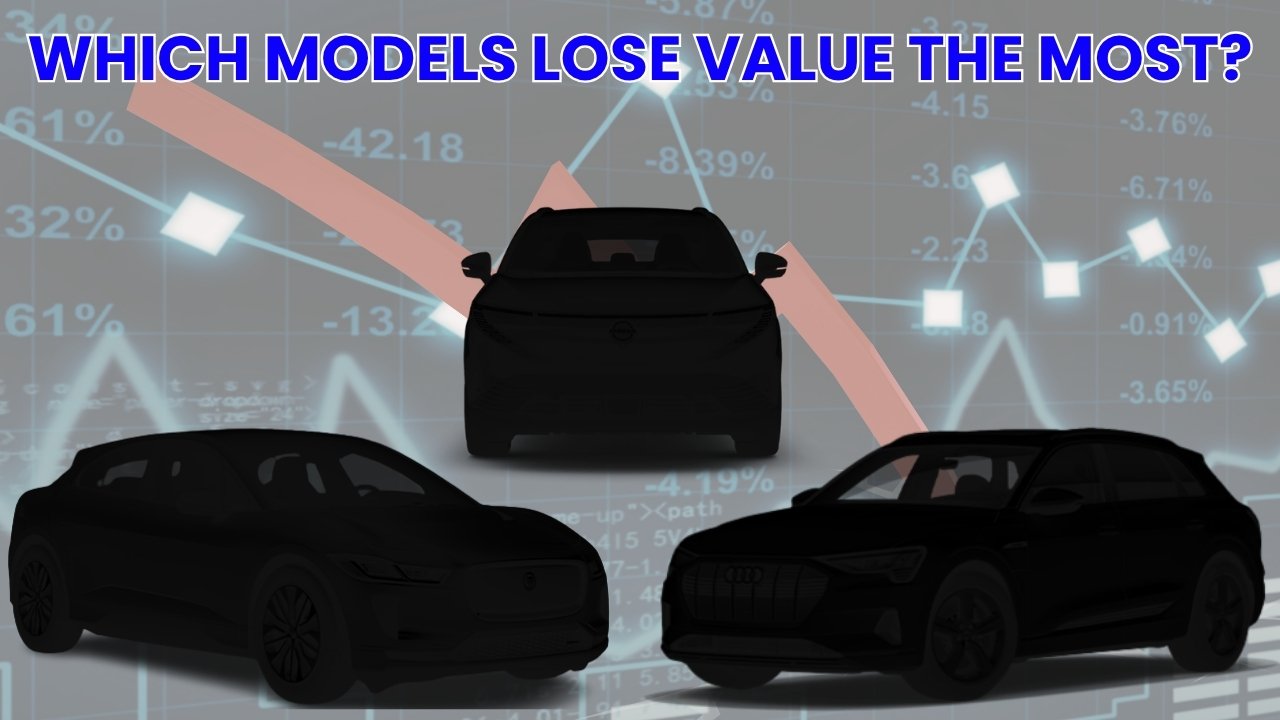
In the last few years, electric vehicles have grown in popularity across the globe, including in the United States, but the main problem with them is their resale value. Compared to gas and hybrid vehicles, EVs depreciate much faster.
Even with 5 years of use, a gas or hybrid vehicle’s resale value gets up to 60% of the purchase cost, but the EVs hardly get 40%. If you are planning to buy one, you must be aware of which electric vehicle models in the US lose most of their resale value and why.
EVs Which Loses Most of Their Resale Value
In the United States, there’s a list of electric vehicles that lose their resale value so quickly. Here, we have talked about only a few EVs whose depreciation happens in a very short while with the actual reason behind it.
Jaguar I‑Pace
It is an all-electric SUV that was introduced in the US market back in 2018. It comes with a double-motor setup featuring an AWD configuration; its most recent variant is available in the country with the price of $72,500.
It loses its resale value from 70 to 72 percent after 5 years of use, which means if you buy it today at the cost of $72,500, after five years you will hardly get $21,750.
The reason behind such high depreciation is that it has very old battery technology, offers lower range compared to newer electric vehicles, and its demand in the used-EV market is even lower.
Audi e-tron
It is currently known as the Q8 e-tron; the company launched it back in September 2018, and then it arrived at the dealership in 2019. It was renamed to the Q8 e-tron in 2024 and introduced with the price ranging between $49,800 and $62,200.
In the second-hand EV market, its resale value is reduced by 70 percent from the purchase price in the case of five years. It means if you had bought a Q8 e-tron for $49,800, the maximum you would get is $14,990 in case of reselling after 5 years of use.
The reason behind the quick depreciation is its very high starting price; its range and efficiency are also very low compared to others, and new models are quite better than it.
Nissan Leaf
It is the world’s oldest electric vehicle, which was introduced in the US market in 2010 with the price of $32,780. Its most recent variant released in the country is available with the same pricing; it also loses its resale value by 65-70%.
The main reason behind its high depreciation is that it still uses the old design and old technology, there is very little range in the older variant, and EV technology is evolving rapidly.
Even if you buy the most recent variant of the Nissan Leaf, you may get only 35-40% of the purchase value in case you resell it after 5 years, but if you opt for an ICE variant, you may get up to 60% depreciation.
What EVs are losing their resale value so fast?
The three EVs mentioned above aren’t the only all-electric vehicles that have very low depreciation; there are a dozen more that lose their resale value over time. The main reason behind it is that with passing time, EVs are getting better and better.
Compared to 2020, in 2026, the electric vehicles are totally changed; there’s no comparison between them. Now all the electric vehicles are equipped with smart and high-tech features and come with larger battery packs, ultra-fast charging, and long range.
If you are planning to buy an electric vehicle and want the one for which you get slightly better resale value, then choose the one that uses the most advanced technology, gives the longest range with larger battery packs, and supports ultra-fast charging.
Before making any decision to buy any EV, make sure you keep one thing in mind: in the next five years, the EV may be more advanced. So there is a very low chance even if you buy any electric vehicle with the latest technology that you will get 50% of the purchase value in case of reselling after 5 years.