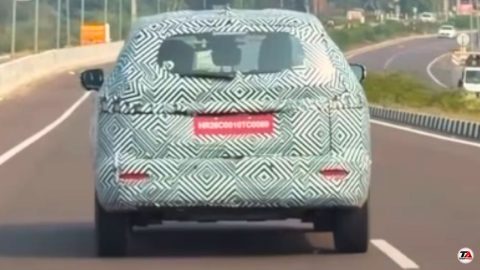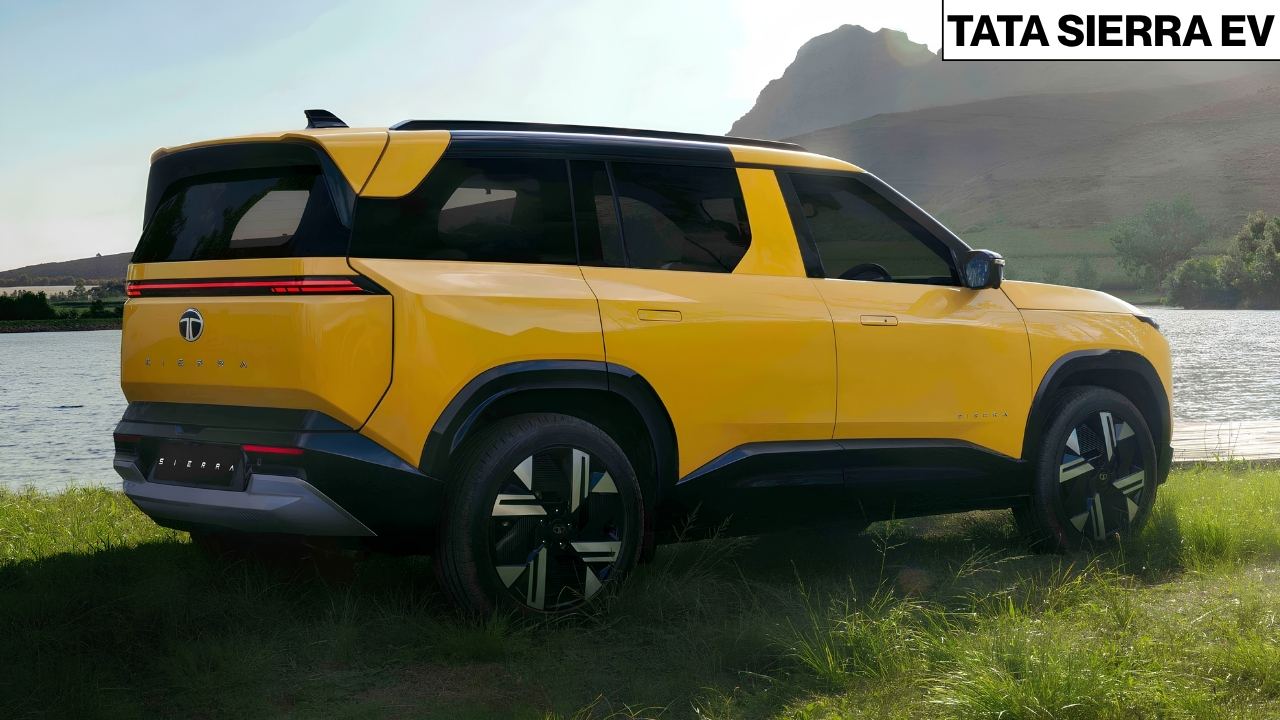
A report from Cartoq claims that Tata Motors will launch the Tata Sierra EV in June 2026, although the carmaker is yet to confirm the actual date. We expect that they will introduce this EV in the Indian market by the end of the month. As of now, there’s no word about the price; various reports suggest that it may cost ex-showroom between 20 and 25 lakh rupees, depending on the battery pack.
In Tata Motors’ electric vehicle lineup, the upcoming Tata Sierra EV will sit above the Tata Curvv EV and below the Tata Harrier EV. As of now, a total of six models from the carmaker are available for sale in the Indian market, and all of them are derived from their ICE (internal combustion engine) counterparts; even the upcoming Sierra EV is based on the one already on sale with a traditional powertrain.
With the launch of the Sierra EV, Tata Motors will have seven EVs in the Indian market with pure-electric powertrains. Notably, following the launch of the upcoming Tata Motors’ battery-powered mid-size sport utility vehicle, it will compete with the other passenger electric vehicles from the segment; mainly, it will take on the Mahindra BE 6, the Hyundai Creta Electric, and the Maruti Suzuki eVitara.
Closed-off grille, large alloy wheels, and connecting taillights
Upfront, it is set to get a closed-off grille, improving aerodynamics and lowering air intakes for cooling of the battery; a split headlight setup; slim, full-width LED daylight running lights just below the nose and narrow main LED headlamps in a horizontal shape; and the bumper-integrated fog lights.
On the sides, it will feature flush-type door handles, large alloy wheels, squared-off wheel arches, roof rails, and ORVMs with integrated side indicators, and the rear gets full-width LED taillights, a roof-integrated spoiler, a hidden wiper, an upright tailgate, a roof-mounted sensor, and a chunky bumper with the silver skid plate.
A triple-screen setup, panoramic sunroof, and 360° camera are expected
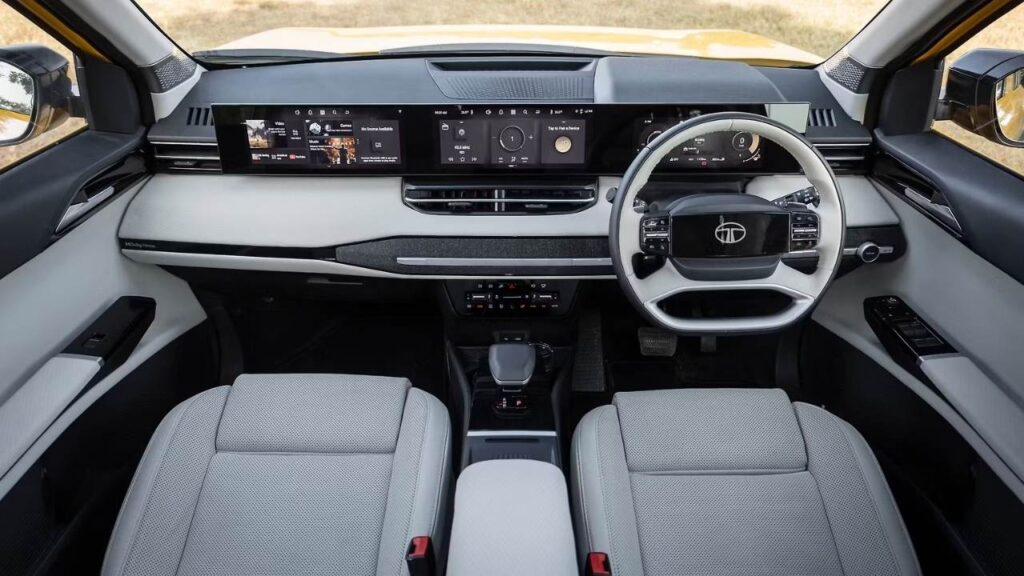
The Sierra EV’s cabin is anticipated to be quite similar to its ICE sibling. Reportedly, the top trims will feature three screens on the dashboard: one under the four-spoke steering wheel as a digital instrument cluster, another on the centre of the dashboard as an infotainment system, and a third before the front passenger seat as an entertainment screen.
The central console may get two wireless phone charging pads that help in charging the phone conveniently for both driver and co-passenger, and for phone charging of rear-seating occupants, it will get USB ports. It will also feature a panoramic sunroof with an electric sunshade; front seats are anticipated to be ventilated and powered, and the driver’s seat may also feature a memory function.
The infotainment system is all set to support wireless connectivity via Android Auto, Apple CarPlay, and Bluetooth and will also feature an AI-based voice assistant that will do things over natural voice commands and OTA software updates helping in software upgrades wirelessly. For safety, the carmaker is likely to add up to eight airbags, a 360° camera, and a level 2 advanced driving assistant system.
Five-person seating capacity with large boot space anticipated
The Sierra EV is all set to be similar in size to its ICE counterpart, which measures 4,340 mm in length, 1,841 mm in width, 1,715 mm in height, 2,730 mm in wheelbase, and 205 mm in ground clearance. It will come with a seating capacity of 5 people in a layout of 2-3 with boot space that may be more than the one found in the ICE variant because of the flat floor. We expect that its cargo capacity will be above 700 litres, which may expand up to 1350 litres.
Two LFP battery options and AWD drivetrain anticipated
As of now, there are no details regarding the powertrain and performance of the Sierra EV; we expect that the carmaker will introduce it with both single-motor front-wheel-drive and double-motor all-wheel-drive drivetrains. Both will use a single-speed automatic transmission. Confirmed to get two LFP battery packs that can be 65 kWh and 75 kWh.
They are likely to launch an RWD variant with both battery packs and AWD with a larger battery pack. The rear-wheel-drive variant with a large battery pack will be the one which may feature the longest claimed range, around 650 kilometres. Reportedly, both variants will feature the electrical architecture of 800 volts supporting fast DC charging.