Audi, the German automobile manufacturer, has revealed the third-generation Audi Q7 on June 9, 2026. They are all set to start the pre-sale in late June 2026 for the European market, and delivery may begin in September 2026. The carmaker may introduce it to the Indian market by the first half of 2027 and will take on the Land Rover Discovery, the Mercedes-Benz GLE and the BMW X5.
Reportedly, they will introduce models with both diesel-powered and petrol-powered internal combustion engines; the former one will be available for sale in Europe with the price ranging from €87,900 to €90,500 (96.90 to 99.76 lakh rupees), and the latter’s cost is still pending; we expect it will be available for sale with the price ranging from €115,000 to €130,000 (1.14 to 1.29 crore rupees).
It’s tough to say anything about its pricing in India. They will launch the model by importing it as a completely-built unit (CBU), meaning it will attract the import duties, so we expect that the price for the diesel-powered variant may be around 1.3 to 1.5 crore rupees, and the petrol-powered may cost 1.6 to 1.8 crore rupees. However, it is still uncertain whether the German carmaker will introduce only petrol-powered variants or diesel-powered ones too.
Split headlights and taillight setup and a long wheelbase
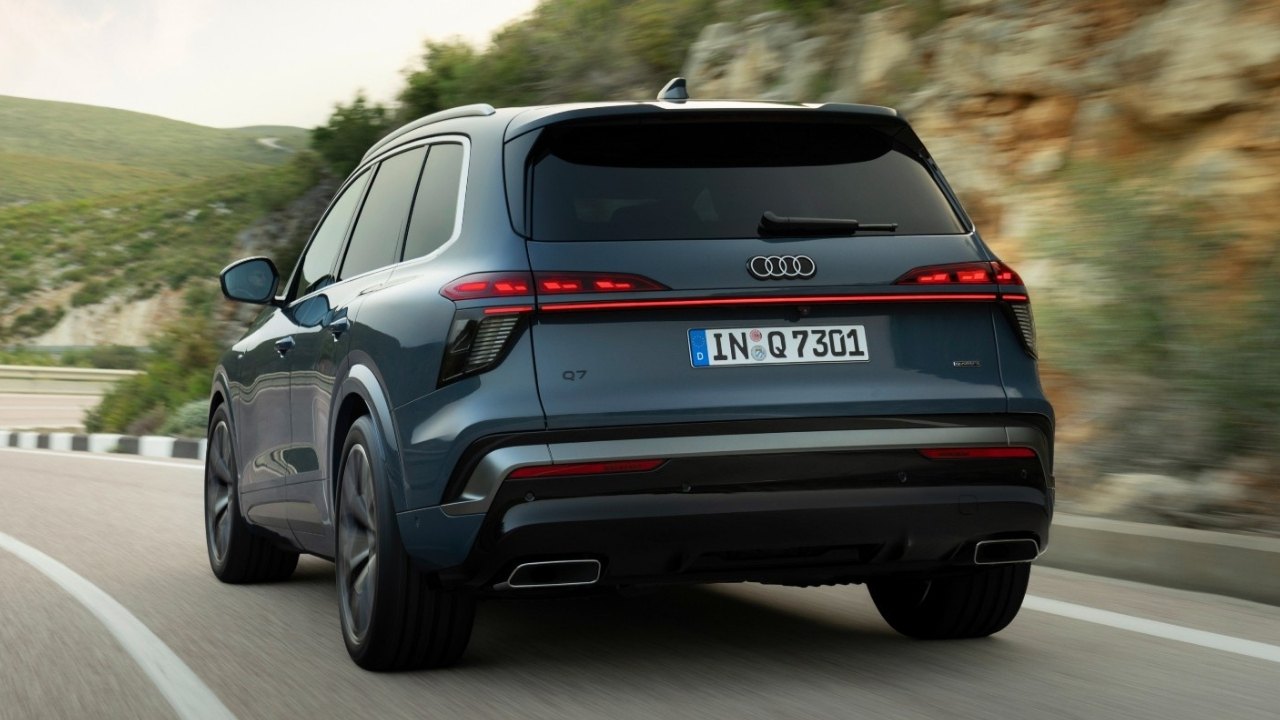
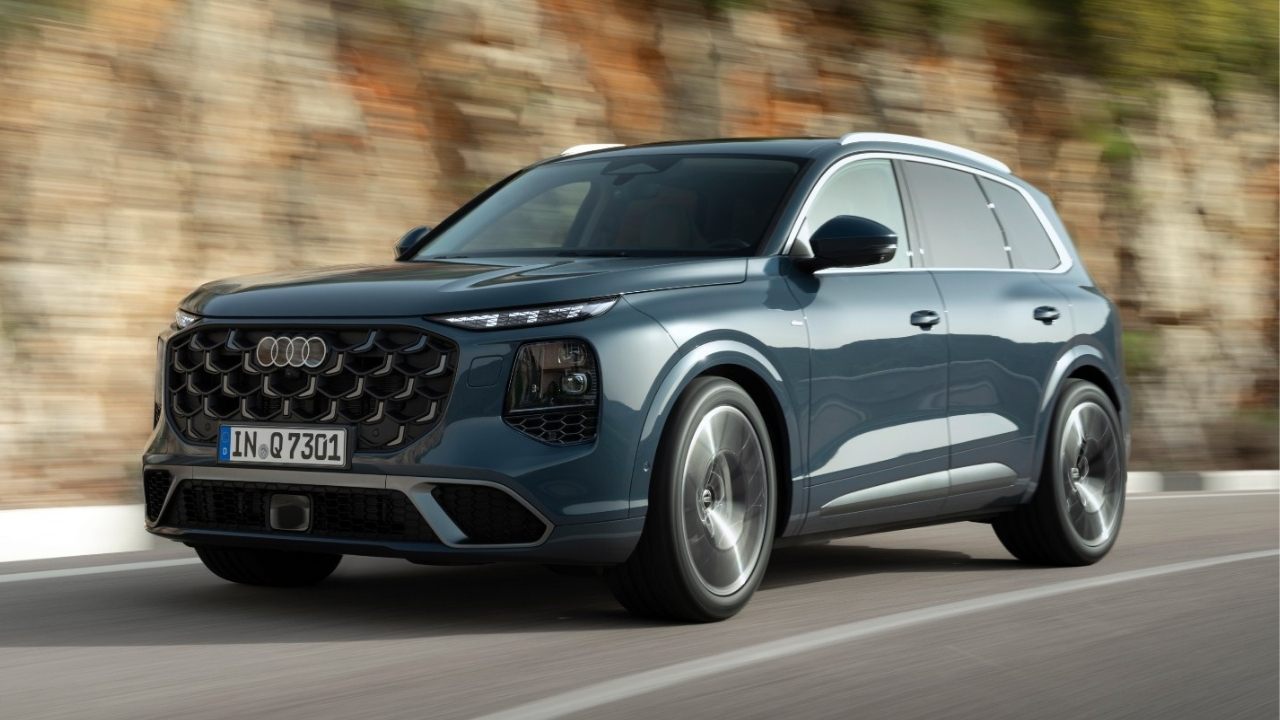
Upfront, the third-generation Audi Q7 features a split headlights setup: the LED daylight running lights are placed above, just below the nose, and the main matrix LED headlights are placed below in a vertical shape; a large grille in a honeycomb pattern featuring Audi’s four-ring emblem; and satin silver skid-plate-style trim. On the sides, it features chrome garnishing on the whole body, flush-type mechanical door handles, slim roof rails, large alloy wheels, and body-coloured ORVMs.
The rear of the vehicle comes with split taillights, features a full-width ultra-slim LED taillight just above the number plate holder, and has main headlamps placed above that with segmented lighting; a roof-mounted spoiler; a shark-fin antenna; a chunky bumper with satin silver trim; and double exhaust. In terms of length, width and height, it measures 5,057 mm, featuring a wheelbase of 2,997 mm, 2,007 mm and 1,803 mm, respectively.
Multiple seating configuration, large boot space and three screens on the dashboard
The third-generation Audi Q7 is available with three different seating capacities: a 5-seater in a 2-3 layout, a 6-seater in a 2-2-2 with captain’s seats in the second row and a 7-seater in a 2-3-2. The 5-seater has a boot space of 670 litres, but the 6-seater and 7-seater have only 581 litres. Notably, folding the rear seats increases the cargo space up to 1980 litres and 2075 litres for the 7-seater and 5-seater, respectively.
Inside, it features a four-spoke steering wheel under which there’s a large digital instrument cluster showing all driving data; a large touchscreen infotainment system is equipped in the centre of the dashboard, exactly above the central console that is angled towards the driver’s seat, which supports wireless smartphone connectivity; and an entertainment screen is at the dashboard before the front passenger seats.
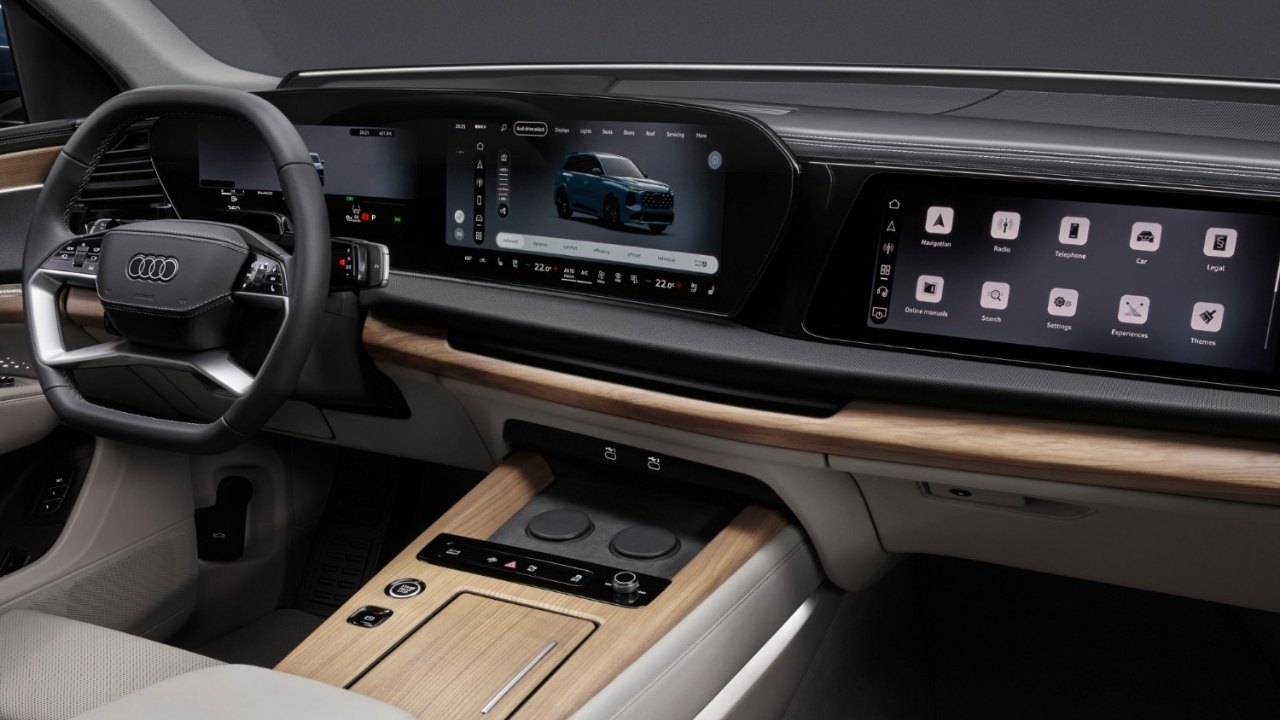
The front row gets two wireless charging pads for convenient phone charging and also features USB-C ports at the rear for phone charging of rear-seating occupants. Get a panoramic glass roof with switchable transparency, and seats feature heating, ventilation and massage functions too. Other notable premium features are the 22-speaker Bang & Olufsen 4D sound system and the Level-2 ADAS suite.
Petrol and diesel engine options with quick acceleration
The third-generation Q7 is built on Volkswagen Group’s Premium Platform Combustion. There are two different internal combustion engine options that are a 2.9-litre twin-turbo petrol V6 and a 3.0-litre diesel V6. Both come with a Quattro all-wheel drive drivetrain and an 8-speed Tiptronic automatic transmission.
The former generates the maximum power of 429 hp and peak torque of 599 Nm, helping to accelerate from 0 to 100 km/h in 4.8 seconds, and its top speed is 250 km/h. The latter is available in two variants: the 45 TDI, which delivers 245 hp power and 500 Nm torque, but the 50 TDI generates 299 hp power and 630 Nm. Both variants are equipped with a 48-volt mild hybrid system which provides a boost of 24 hp power and 270 Nm torque.
The 0-100 kmph acceleration timing is 7 seconds and top speed is 230 kmph for the 45 TDI, but the 50 TDI takes only 5.8 seconds to accelerate from 0 to 100 kmph and can reach the maximum speed of 245 kmph. Reportedly, it can also run on hydrotreated vegetable oil (HVO), which reduces the carbon emission by 95% compared to regular diesel.