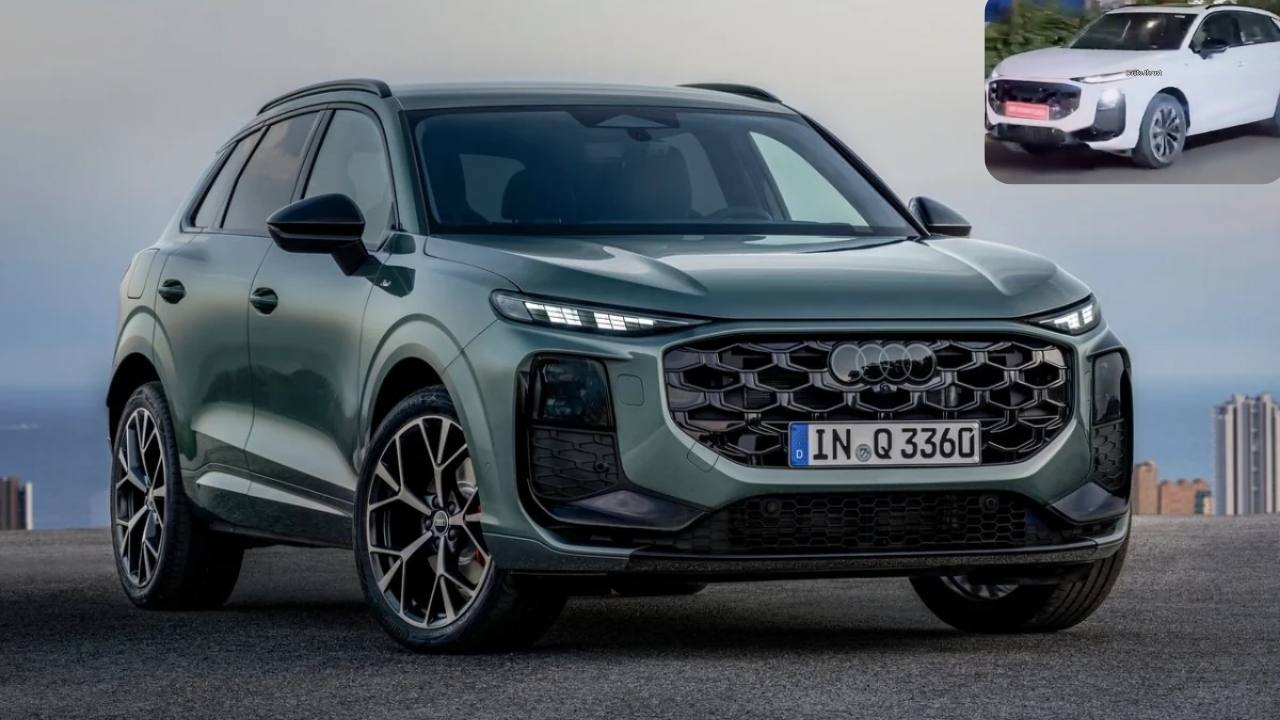
The third-generation Audi Q3, which is all set to be sold as a 2026 model, has been spotted testing on Indian roads. The spy shots of test mules are floating on the web, in which the vehicle is undisguised, revealing all the exterior details. Following the global debut in June 2025, this is the first time the vehicle is spotted undisguised in India.
Audi, a German luxury automobile manufacturer, hasn’t confirmed any date for the launch, but there’s a high speculation that they will introduce the model in Diwali 2026 with a starting ex-showroom price of ₹50 lakh. Following the launch, it is all set to give tough competition to the BMW X1, the Mercedes-Benz GLA, and the Volvo XC40.
The spy shots floating on the web show that it has slim LED daylight running lights below the hood and bumper-integrated high beams lower on the front end. Other notable features on its front fascia are a large octagonal single-frame grille with a four-ring Audi logo and a sporty bumper with large black air intakes to ensure better fuel efficiency.
In profile, it has pronounced wheel arches, mechanical pull-type door handles, roof-mounted rails, multiple-spoke alloy wheels, and a front-door-mounted outside rear-view mirror; and the rear boasts a full-width LED taillight that connects the LED taillamps, a roof-mounted shark-fin antenna, a roof-integrated spoiler with a braking system, and a four-ring Audi logo at the tailgate.
In the international market, it is available for sale with four different powertrains. The first one is 1.5 TFSI, which gets a 1,498 cc 1.5-liter TFSI turbocharged four-cylinder petrol engine with a 48V mild-hybrid system with cylinder-on-demand. Its combined power output is 150 PS, and peak torque is 250 Nm, which accelerates from 0 to 100 km/h in 9.1 seconds, and top speed is 210 km/h.

The second one is the 2.0 TDI. Under the hood, it features a 1,968 cc 2.0-liter TDI turbocharged four-cylinder diesel engine, whose power output is 150 PS and peak torque is 360 Nm. The top speed is 205 km/h, and acceleration timing for 0 to 100 km/h is 9.2 seconds. Third is the 2.0 TFSI Quattro; it gets a 1,984 cc 2.0-liter TFSI turbocharged four-cylinder petrol, which generates 265 PS of power, and peak torque is 400 Nm.
Its 0 to 100 km/h sprinting time is 5.7 seconds, and maximum speed is 240 km/h. Notably, all these internal combustion engines are mated with a 7-speed S tronic dual-clutch automatic. The drivetrain for the first two is front-wheel drive, and the third one is an all-wheel-drive drivetrain. The fourth is a PHEV; it gets a 1.5-liter TFSI turbo-petrol engine and electric motor. They are mated with a 6-speed automatic featuring a FWD drivetrain.
The combined power output is 272 PS, and peak torque is 400 Nm. Under the floor, it has a 25.7 kWh lithium-ion battery pack whose emission-free WLTC range is 119 km. The acceleration timing for 0 to 100 km/h is 6.8 seconds, and the top speed is 215 km/h. It supports a 50 kW DC charger, which takes 30 minutes for 10 to 80 percent charging. Reportedly, the one coming to India is the third one, which comes with an AWD drivetrain.
Dimensionally, it is 4,531 mm longer. The width is 1,859 mm without the mirrors and 2,087 mm with the mirrors. Its height ranges from 1,588 mm to 1,623 mm, depending on wheel size and suspension. It has a wheelbase of 2,680 mm. The front and rear tracks are 1,590 mm and 1,576 mm, respectively. The boot space is 488 liters, which is expandable to 575 liters by sliding. By folding the rear seat, boot space can be expanded up to 1,386 liters.