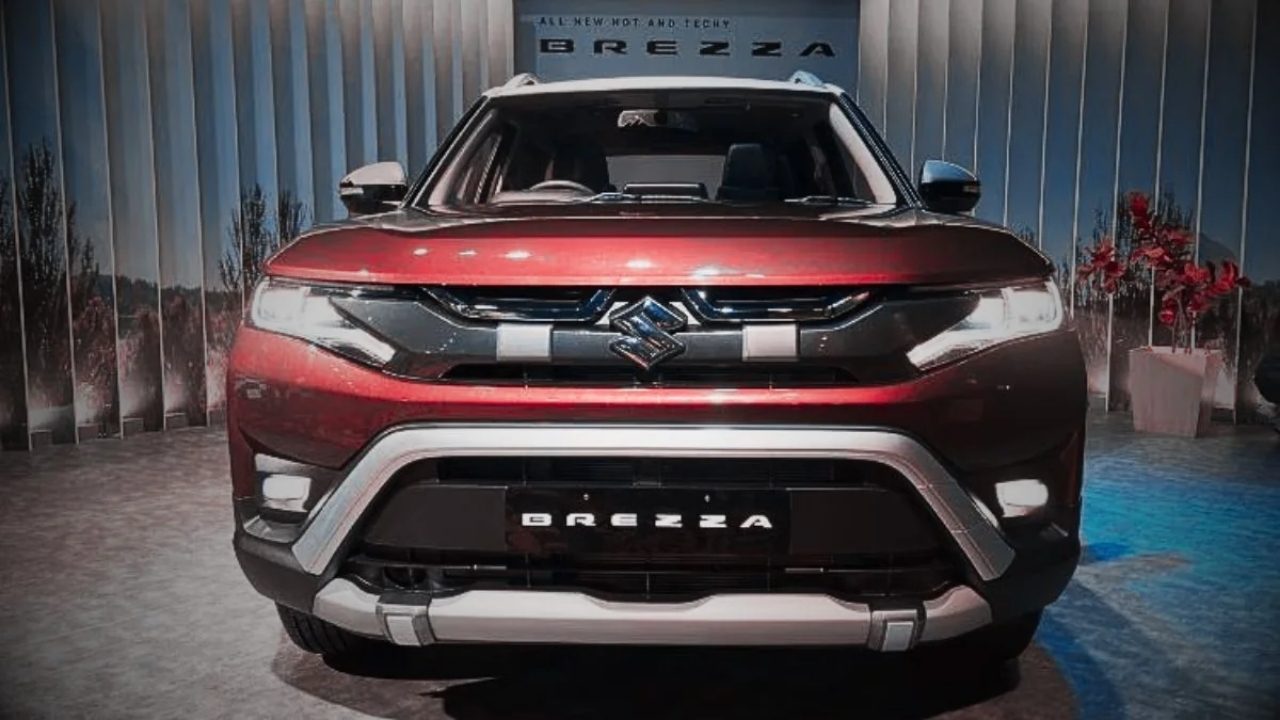
Maruti Suzuki, the Indian automobile manufacturer, has officially confirmed that they are going to launch the 2026 Maruti Suzuki Brezza on July 23, 2026, with many upgrades. The facelift of this sub-4-metre sport utility vehicle will make its debut with slightly costlier pricing than the existing one.
The current model of the Brezza available for sale in the Indian market costs ex-showroom between ₹8.26 lakh and ₹12.86 lakh. It is expected that the refreshed version will cost from ₹9 lakh to ₹14 lakh. After the launch it will give more tough competition to the Tata Nexon, the Skoda Kamiq, and the Kia Sonet.
Before the launch, its test mules had already been spotted testing multiple times, revealing the changes it is most likely to get. Outside, it will have a revised front bumper with revised air intakes and shaper lines to give a more rugged and modern appearance, an upgraded grille to enhance road presence, and updated LED headlights to give it a premium look.
Other upgrades we may get to see on the exterior are new four-spoke alloy wheels, improving visual appeal; a new rear bumper with a refreshed side reflector and cladding, adding a tougher SUV stance; a refreshed front-door-mounted outside rear-view mirror, giving better visibility of traffic behind; and new colour options, offering more personalisation options to buyers.
Spy shots floating on the web even show the interior through the side window, which reveals that the centre of the dashboard will get a large touchscreen for information that may be 10.1 inches longer, which may support wireless multi-device connectivity, over-the-air software, an AI-based voice assistant and connected car technology.

Expected to get a revised dashboard with the soft-touch trims and upgraded upholstery for the seats for better seating comfort. Most likely to get a three-spoke revised round-shaped steering wheel with physical buttons, under which there may be a digital instrument cluster which shows all driving data.
May reports suggest that that top-end variant will now come with ventilated and powered seats for better comfort for the driver and co-passenger. We may also get to see the inclusion of a wireless phone charging pad on the centre console, ambient lighting on the dashboard, and roof-integrated air conditioning vents for the second row.
In addition, a 988cc 1.0-litre three-cylinder Boosterjet turbocharged petrol-powered internal combustion engine is expected, which generates power up to 100 hp and peak torque of 148 Nm. The transmission option is expected to be a six-speed manual, and an automatic may come later, and the drivetrain is set to be front-wheel drive.
The option is a 1462 cc 1.5 litre four-cylinder naturally aspirated petrol-powered ICE is set to be retained, and they will also be going to introduce a CNG variant with it. In pure petrol mode, it generates the power of 103 PS and torque of 137 Nm, but in the case of CNG mode, it delivers 88 PS and 121.5 Nm.
The pure-petrol version features mild-hybrid technology to ensure better efficiency and comes with both a five-speed manual and a six-speed automatic transmission, and the CNG version has only a five-speed manual gearbox option, and the drivetrain for both is front-wheel drive.
Notably, Maruti Suzuki launched the nameplate back in March 2016; since then, as of December 31, 2025, they have sold 14,08,271 units. The sale figures for 2026, between January and May, is 77,498 including 17,486 in January, 17,863 in February, 14,600 in March, 14,124 in April, and 13,425 in May.
Meaning, as of May 31, 2026, they have sold a total of 14,85,769 units. They registered the month-on-month growth of 2.1% in February, degrowth of 9.7% in March, decline of 12.4% in April, and dip of 5% in May.