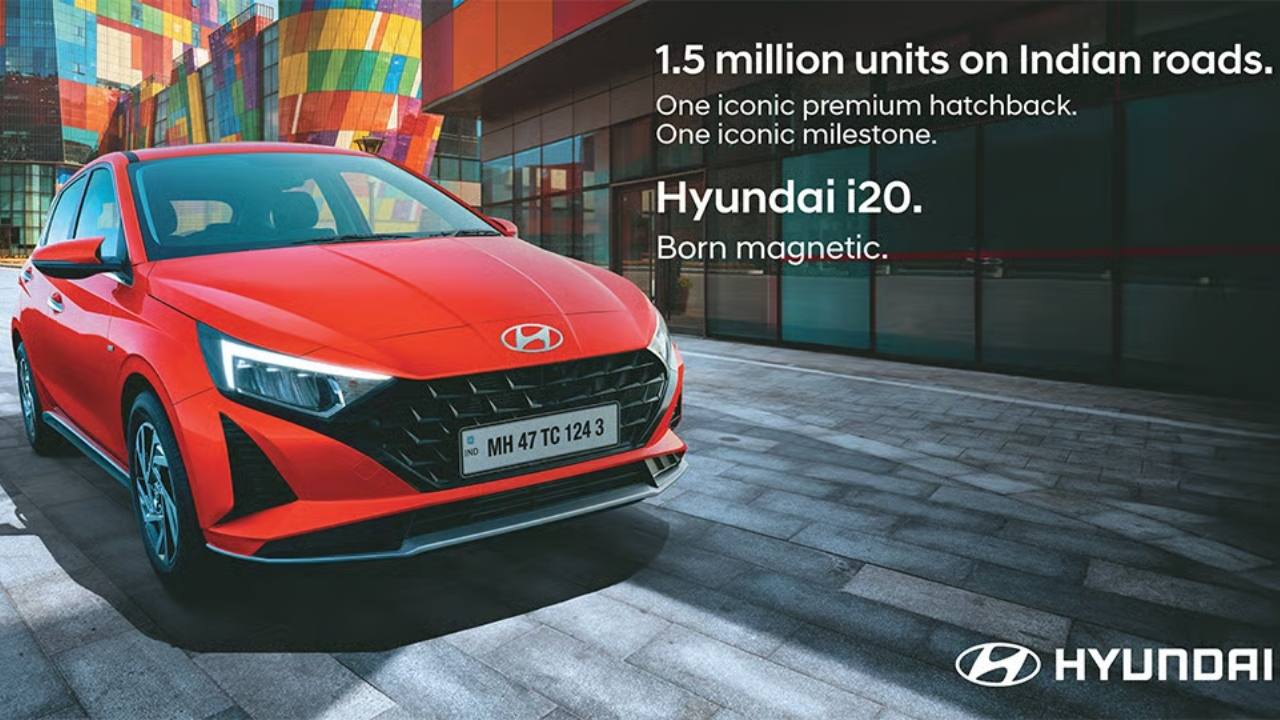
The Hyundai i20, a premium hatchback from Hyundai Motor Company, made its debut in the Indian market in 2008. Since then, more than 15 lakh units have been sold as of July 24, 2026. It is available for sale in the Indian market as standard and N Line, with the ex-showroom price of ₹6.00 lakh to ₹10.00 lakh and ₹9.27 lakh to ₹11.74 lakh, respectively.
The length, width, and height are 3,995 mm, 1,775 mm, and 1,505 mm, respectively. Its wheelbase is 2,580 mm, ground clearance is 170 mm, boot space is 311 liters, and fuel tank capacity is 37 liters. Built on Hyundai’s K2 platform with a front-wheel-drive architecture. Its front suspension is a MacPherson strut suspension with coil springs, and the rear is a coupled torsion beam axle with coil springs.
It also features electric power steering, which ensures lighter steering effort and improved steering precision. The front wheel gets ventilated disc brakes, and the rear comes with drum brakes. In most variants, a few are available with solid discs. Notably, the standard variant has 15-inch steel wheels or 16-inch alloy wheels and 16-inch diamond-cut alloy wheels.
For the safety of occupants, it also has Electronic Stability Control, Vehicle Stability Management, Hill Start Assist Control, an anti-locking braking system, Electronic Brake Force Distribution, six airbags, and a Tyre Pressure Monitoring System. Its main rivals in the Indian market are the Maruti Suzuki Baleno, Toyota Glanza, and Tata Altroz.
The standard version is equipped with a 1.2-liter four-cylinder Kappa naturally aspirated petrol-powered internal combustion engine, whose displacement is 1,197 cc. It features a multi-point injection system. The power output is 88 PS at 6,000 rpm, and peak torque is 114.7 Nm at 4,200 rpm.
It is available with two different gearbox options: a 5-speed manual and a continuously variable transmission. The IVT is available with two different driving modes: Normal and Sport. The N Line gets a 998 cc 1.0-liter three-cylinder turbocharged petrol-powered internal combustion engine, which generates the power of 120 PS at 6,000 rpm and 172 Nm at 1,500 to 4,000 rpm.
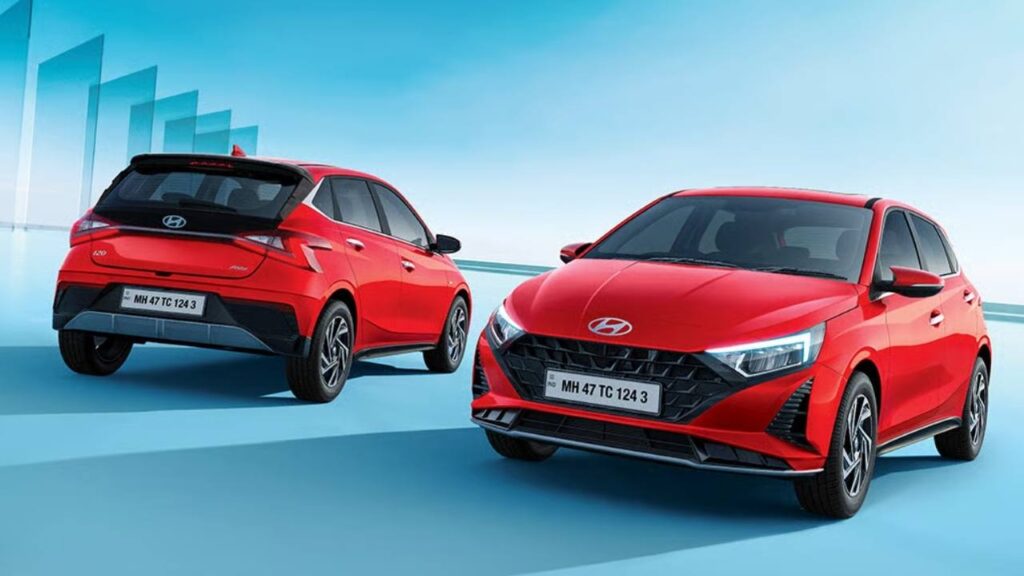
It comes with two gearbox options: a six-speed manual and a six-speed dual-clutch transmission. It is available with drive modes: Eco, Normal, and Sport. The ARAI-certified range is 20.35 km/l for manual and 20 km/l for automatic. Inside, it has a dual-tone black and grey interior with silver inserts and an all-black interior with brass-colored inserts.
Other notable features include ambient lighting, a front center armrest with storage, a rear parcel tray, a sunglass holder, a height-adjustable driver’s seat to sit comfortably with height adjustment, and adjustable front and rear headrests. The center of the dashboard gets a 10.25-inch HD touchscreen infotainment system with turn-by-turn navigation.
The centrally mounted screen supports wireless Apple CarPlay and Android Auto for audio and video streaming. It also features Hyundai Bluelink connected car technology and over-the-air (OTA) map updates. It also supports voice recognition and Bluetooth connectivity. The infotainment system is integrated with the BOSE premium 7-speaker audio system with subwoofer.
It also has steering-mounted audio and phone controls. A wireless phone charging pad is available at the center console that helps in charging the phone conveniently. Under the steering wheel, it gets a digital instrument cluster with a TFT multi-information display that shows all the driving-related data clearly.
Other notable features inside the cabin are rear AC vents for the comfort of rear seating passengers by keeping cool in summer and warm in winter; smart key with push-button start or stop; cruise control; parking sensor display; trip computer; and gear shift indicator.