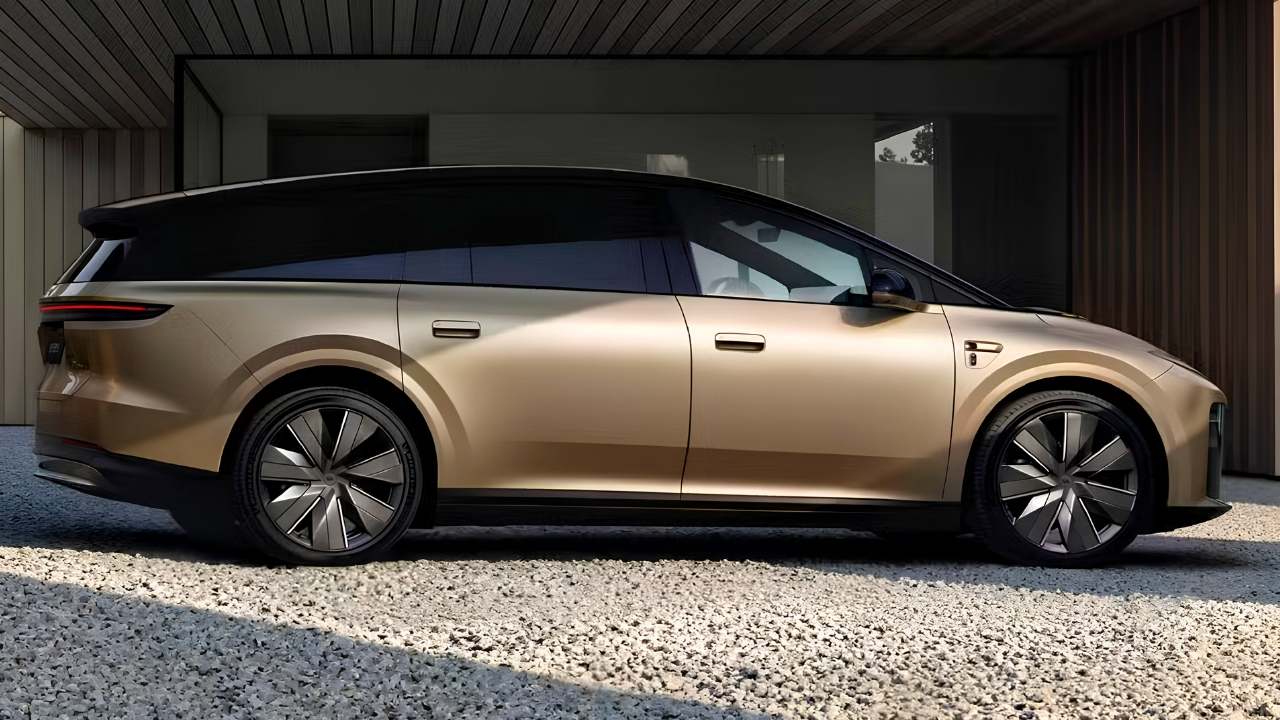
Li Auto, the Chinese EV manufacturer, has tested the upcoming Li i9, the flagship all-electric family sport utility vehicle, by releasing an image that shows the side of the vehicle. The company’s founder and CEO, Li Xiang, has officially confirmed that they will introduce the model in China in September 2026. It is set to be the longest SUV from the company, with a length of 5,225 mm and a wheelbase of 3,168 mm, as it is 140 mm longer and has 118 mm more wheelbase than the Li i8.
The image they have shared online reveals that it gets flush-type door handles to reduce drag and improve efficiency with better aerodynamics; flared wheel arches to add style to the in-profile view; seven-spoke large alloy wheels enhancing the road presence; a blacked-out A-pillar integrated outside rear-view mirror to get a clear view of the blind spot; and ORVMs integrated with blinkers to give a clear view at night to other road users, and the blacked-out pillar creates a floating effect.
Notably, the image also reveals a few portions of the rear; it gets full-width through-type LED taillights, creating a wide stance, and a roof-integrated spoiler to reduce turbulence at high speed. Automotive enthusiasts have already spotted the Li i9 testing in China, whose spy shots are already available on the web, but it is highly camouflaged. The spy shots confirm that it has a closed-off grille, a roof-mounted lidar sensor, bumper-integrated air intakes, and a full-width LED daylight running light.
The carmaker is yet to reveal its specifications and features. Set to be based on an 800-volt high-voltage electrical architecture supporting ultra-fast charging. Many reports have confirmed that it will be introduced as an all-wheel-drive vehicle, meaning it features a permanent magnet synchronous motor on the rear axle with a one-speed automatic transmission and an induction motor on the front axle. Notably, it is also rumored to make its debut with a triple-motor setup, one in front and two on the rear axle.
The lithium-ion nickel manganese cobalt battery pack of above 100 kWh is most likely giving the range of 750 km on the China light-duty vehicle test cycle. May support 5c charging, which is capable of adding the claimed range of 500 km with 10 minutes of charging. The acceleration timing for 0 to 100 km/h is anticipated under 4 seconds, with a top speed of 200 km/h with a double-motor setup. If the three-motor setup arrives, then it will have quicker sprinting and faster speed.
The carmaker has officially confirmed that the Li i9 will make its debut with a three-row, six-person seating capacity in a 2-2-2 layout. As it is longer than the Li i8, it will have a huge boot space that enables the carrying of big luggage conventionally. All seats are expected to be ventilated, heated, electronically adjustable, and feature a massage function. But the front-row seats are most likely to feature a memory function, and the second-row seats are zero-gravity with separate armrests and leg support.
Its dashboard is set to be equipped with two large touchscreens, one at the center as an infotainment system and the other before the co-passenger seat for entertainment purposes. May features a four-spoke steering wheel with controls mounted on it; it is very unlikely that there will be a digital instrument cluster under it. Instead of that, a panoramic head-up display is expected, showing all the driving data on the windshield to stay focused on driving.
Likely to get air suspension, rear-wheel steering, Li AD Max, an advanced driving assistant system with 700 TOPS NVIDIA DRIVE Thor-U chipsets, two wireless phone charging pads at the center console, compartment storage across the cabin, a built-in refrigerator, a panoramic sunroof with an electronic sunshade, and much more. Its price is still uncertain but set to be costlier than the Li i8, which costs 321,800 to 369,800 yuan, so we are expecting that the Li i9 will cost from 399,800 yuan.