On May 25, 2026, the Italian luxury sports car manufacturer Ferrari finally revealed its first all-electric vehicle, the ‘Ferrari Luce’. It is a four-door and five-seater EV with a seating layout of 2-3, with a rear seat bench-type with the 40/20/40 split-folding. Features a boot space of 597 litres, making it the brand’s large cargo capacity car. Its interior is designed by Jony Ive, the co-founder of LoveFrom; the cabin design is inspired by the brand’s car from the 1950s and 1960s.
It has a 12.5-inch OLED (Organic Light-Emitting Diode) instrument cluster under the thinned-rimmed three-spoke steering wheel that looks like three classic analogue dials by showing speed, power data, navigation, and warning indicators; and the centre of the dashboard is equipped with a floating 10-inch touchscreen infotainment system using the ball-and-socket joint, which can be tilted toward the driver or front seating passenger.
Comes with three dedicated e-Manettino EV modes, which are Range, Tour and Performance. Another notable feature is the 21-speaker system, which ensures a theatre-like audio experience. Notably, most of the electric car’s settings are touch-based, though the infotainment system touchscreen and its steering wheel have few physical buttons. These buttons are available for indicators, wipers, cruise control, bumpy road mode and the red Manettino drive selector.
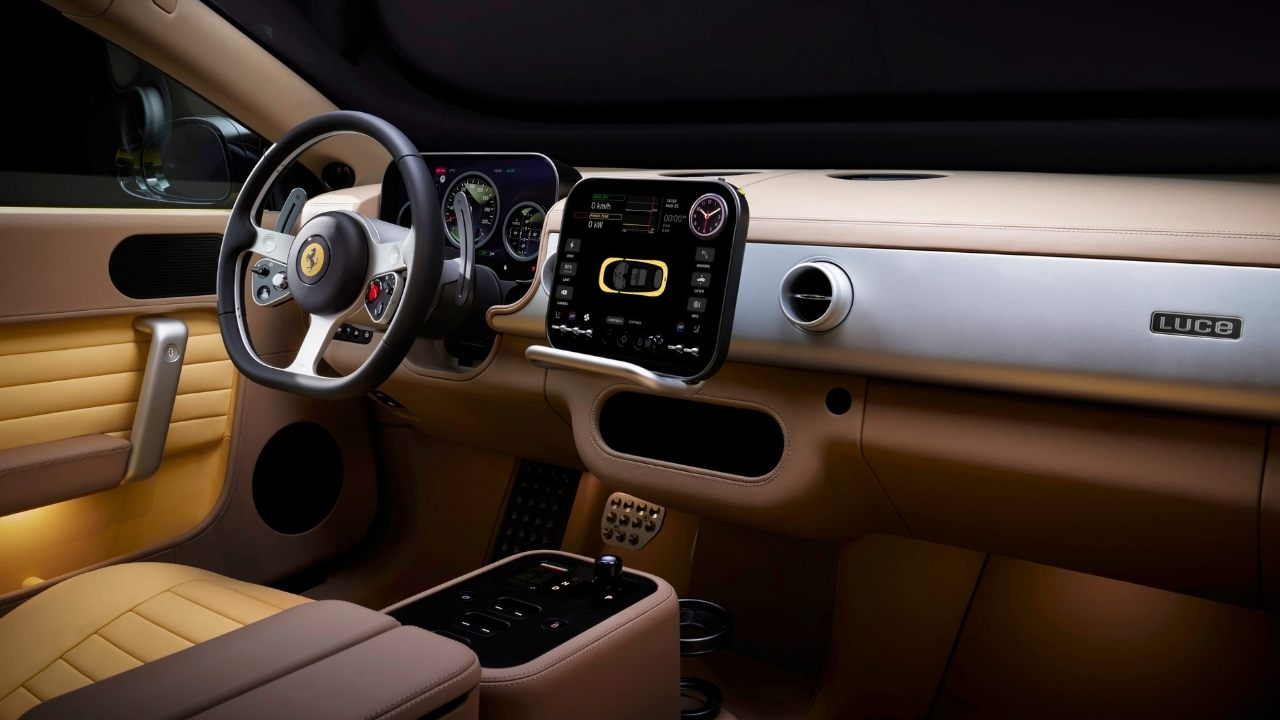
The centre console, the section between the front passenger and driver seats, appears to float over the floor, which is made up with the use of leather and glass for the luxury feel and futuristic appearance. It has a small crystal-like drive selector with options of Drive, Reverse, Neutral and Park, giving an elegant and high-tech feel, and a dedicated key slot; to start the car, the key is required to be placed. Interestingly, doing so changes the colour from yellow to black.
Dimensionally, it is 5026 mm longer, 1999 mm wider and 1544 mm taller. Its wheelbase is 2961 mm, and drag coefficient is 0.254 cD. It sits on 23-inch front wheels and 24-inch rears. Globally, it is set complete with the Lotus Emeya R, Lucid Air Sapphire and Porsche Taycan Turbo GT. Among these rivals, the first one is 113 mm longer, and the second is shorter by 51 mm and 58 mm, respectively, compared to the Ferrari Luce.
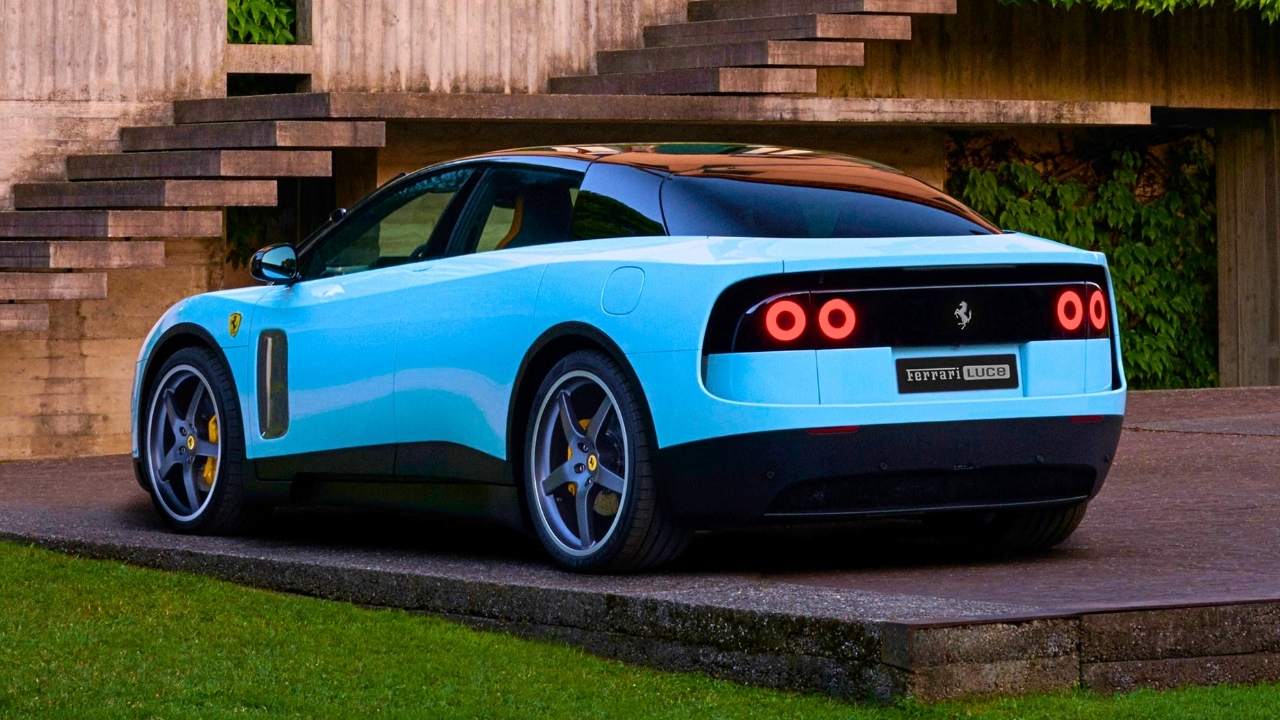
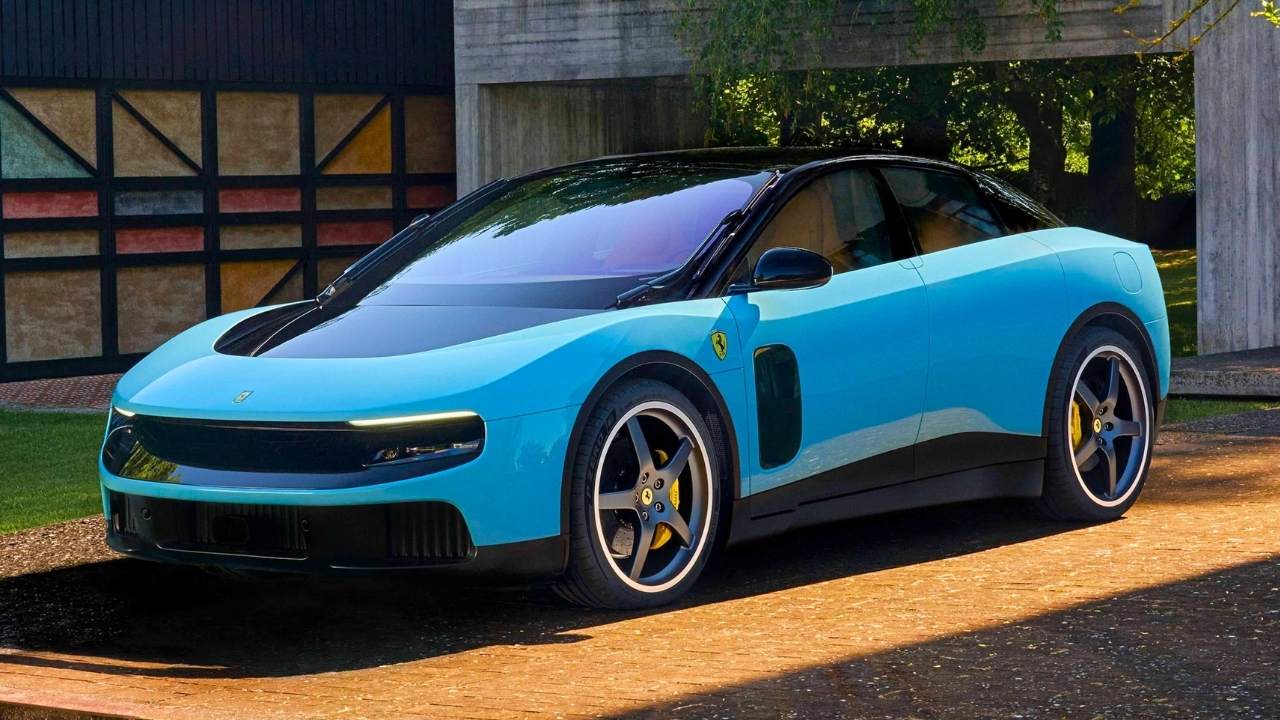
At the front end, it has a floating bridge with integrated LED daylight running, giving the car a futuristic look; hidden headlights that add premiumness; a smooth bonnet that flows directly to the windscreen, improving aerodynamics; and active cooling fins that open and close automatically. On the back, it gets very slim, full-width LED taillights, creating the wide stance, and four circular tail-lamps with the Ferrari logo at the centre for branding.
In profile, it features a fastback roofline which slopes towards the rear windscreen, giving it a GT-like sporty look; five-spoke large alloy wheels giving bold road presence; black strakes behind front wheels to vent air out from the wheel arches; door handles hidden in the pillar to ensure a smooth surface and reduce drag for better efficiency; and blacked-out aero-optimised outside rear-view mirrors, window trims and wheel arches.
As an all-electric car, it is equipped with four electric motors, one with each axle, featuring an all-wheel-drive drivetrain. The combined maximum power output is 1050 hp, and peak torque is 990 Nm with the launch control, which can be activated by pulling down on a grip placed over the head of the driver. The acceleration timing for 0 to 100 km/h is 2.5 seconds, and the top speed goes up to 301 km/h.
Notably, the standard power output with the Range, Tour and Performance drive mode is 430 hp, 617 hp and 986 hp, respectively. Equipped with a 122 kWh LFP battery pack with an electrical architecture of 800 volts, on a full charge, its WLTP range is 530 km. Support DC charger up to 250 kWh, which takes 22 minutes for 20 to 80 per cent charging that adds the WLTP-range of 280 km.