Whenever you check the specification of any vehicle, you get to know about important things that are power and torque. Many people understand the power which is usually shown with BHP, PS or KW, but they often get confused about the torque, what it is and what it actually does.
If you are planning to buy a vehicle and while going through the specification check you got to know about the torque in Nm or lb-ft and you have no idea what it actually means? Then no need to worry! Here, we have discussed all about the torque of a vehicle.
What is the torque?
In simple words, you can understand that torque is rotational force. I understand this is not the answer you are looking for! So below we have tried to explain it in simple words with real-life examples so you actually understand what the torque actually means.
Let’s talk about the traditional car, like petrol- or diesel-powered; we all know that it comes with an engine. When any vehicle engine runs, it moves the crankshaft, a component of the engine that turns the up-and-down motion to round-and-round motion; that turning power is called ‘torque’.
Let’s understand it with a real-life example. Suppose you try to remove a bolt from a machine using the wrench; The more force you apply on the wrench, the easier it becomes to loosen the bolt. You can also check out Mahindra XUV 7XO Hits 70,000 Sales Since Launch. Here, the rotating force you used to remove the bolt is the torque. Hope you understand its meaning!
How is the torque measured?
Internationally, the torque of any vehicle is measured in units: the first one is Newton-metre (Nm) and the latter is pound-feet (lb-ft). The Nm is used across Asia and Europe to measure the torque, and the lb-ft is used across the American continent.
Suppose that the car you are interested in generates the torque of 185 Nm/136 lb-ft; it means that the vehicle’s engine generates 185 newtons/136 pounds of force to rotate at a distance of 1 metre/1 foot.
How does torque work in a car?
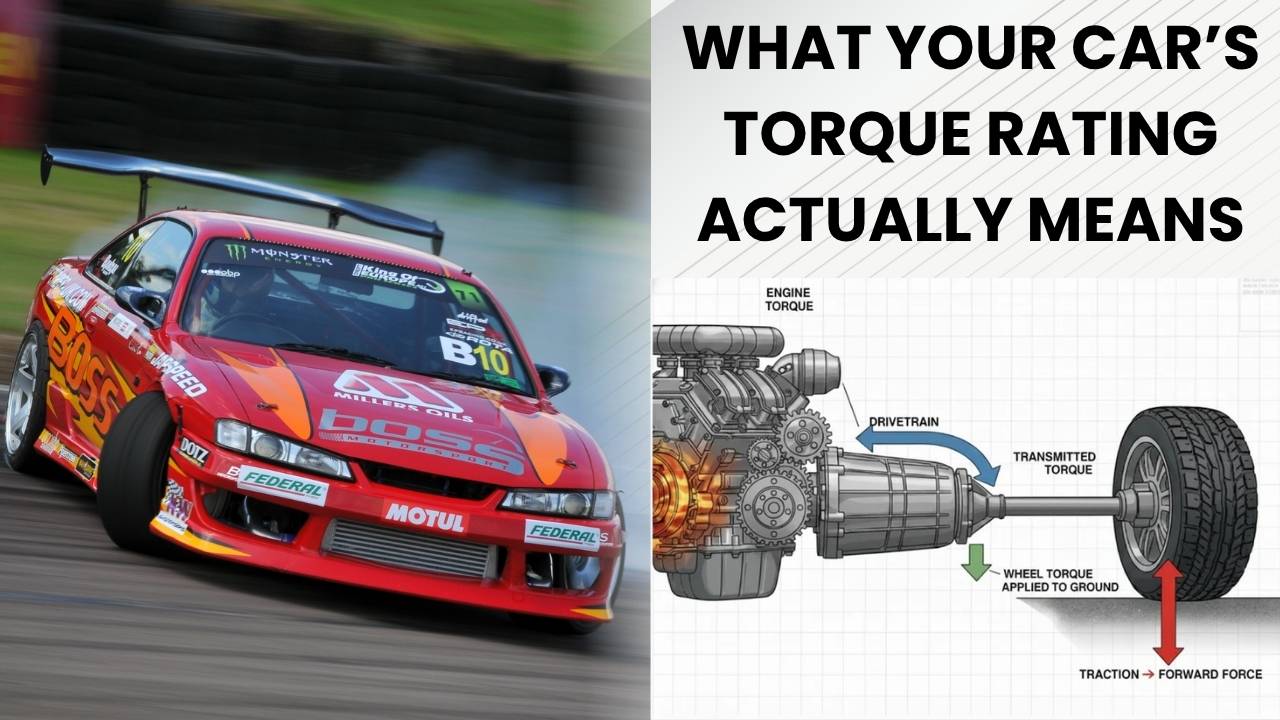
To understand how the torque works in a car, you have to know the power flows from engine to wheels. Before jumping to the point to understand how it works, note one thing: the torque is the rotational force which moves the wheel of a vehicle.
- The process starts with the engine. Inside the engine’s cylinder, the fuel and air mix, which burns with spark/pressure and releases energy.
- The burning of fuel generates the gases which pushes the pistons up and down.
- The piston is connected with the crankshaft through a connective rod, and the up-and-down movement of the piston moves the crankshaft round and round and generates the torque.
- The crankshaft is joined with the flywheel, which stabilises and smooths the torque.
- In the car with manual transmission, the clutch is between the engine and gearbox, which plays a crucial role in sending/stopping the torque from sending it further.
- The gearbox of the vehicle adjusts the torque. The lower gear increases the torque for inclining, and the higher gear decreases the torque and increases the speed.
- After passing the gearbox the torque passes through the drivetrain that includes the driveshaft, differential and axle. The axle transfers the torque to the wheel, which moves it.
What about the torque in EV and hybrid vehicles?
The EV includes a motor and battery; the battery stores high-voltage electricity, and when the accelerator is pushed, it generates power. The controller converts the DC power to AC and also controls the motor. The motor generates the torque even at 0 rpm, and as the EV has a single-speed automatic transmission, the torque directly reaches its wheel and moves it.
But the hybrid car has two sources that generate the torque: the electric motor and the internal combustion engine. When the car moves slowly, the motor works independently, and after the acceleration, both engine and motor generate the torque. During highway cruising, the engine plays the main role, but the motor helps when needed, and in case of braking, the motor acts like a generator and stores the energy back to the battery.